Lawmakers pass too few good bills and too many that need the boot.
By Stella Koch, Virginia Conservation Advocate
LAND USE AND TRANSPORTATION
There were more than 20 bills proposed that would have given localities additional authority to manage growth. Of those, only a few actually passed. One, Senate Bill (SB) 373 allows localities to use Transfer Development Rights (TDRs) to direct growth to the right places. House Bill 1513 also passed. It requires localities to prepare and consider traffic impact analysis prior to approving changes to zoning ordinances. Although most Northern Virginia counties have been doing this for decades, not all of the Commonwealth jurisdictions have. Many of the proposed growth management bills never reached the floor for a vote, including bills that would have allowed localities to deny requests for changes to zoning ordinances if there was inadequate road capacity; given tax credits for employers who encourage transit use; required more disclosure of conflict of interest in local zoning cases; and, for the third year in row, one that would have required vehicles to stop for pedestrians in crosswalks.
AIR QUALITY
Instead of considering bills that would have required real reductions in air pollutants, the Virginia legislators passed two industry-sponsored bills, SB 651 and its identical HB 1055. These bills allow power plants to participate in the lax Environmental Protection Agency cap and trade system in order to meet their Nox (nitrogen oxide) and SO2 (Sulfur dioxide) and mercury reduction obligations. Permitting mercury trading has dire health implications for those living near a plant releasing unhealthy amounts of mercury that would choose to “trade” their way into compliance. Mercury, unlike other gases, does not easily disperse, and so settles into the areas surrounding these power plants. And these bills permit a power plant, such as the Mirant plant in Alexandria, to buy mercury trading credits from anywhere within a 200-mile radius.
ENERGY
SB 262 is a complex energy bill that does not place enough emphasis on energy conservation; it also opens the door to offshore drilling in Virginia. It was, however, successfully amended in committee so that local zoning and planning and the health and safety of minority communities can be considered in the siting of new energy facilities.
WATER
HB 1185 allows Virginia Department of Environmental Quality (DEQ) authority to regulate surface water (river and stream) withdrawals by agricultural operations only AFTER adverse impacts in streams and rivers have occurred and been documented. This bill opens the possibility of adverse impacts to occur to public water supplies, fish and wildlife populations and habitats, and downstream riparian owners in an effort to provide “water rights” to farmers first. This bill also jeopardizes a four-year effort to ensure a stable water supply for all private and public uses of water in Virginia.
HELP PROTECT VIRGINIA’S ENVIRONMENT
Call or write Gov. Kaine, and ask him to veto these bills (www.governor.viginia.gov or State Capitol, 3rd floor, Richmond, VA 23219 or 804-786-2211)
SB 651/HB 1055, which allows mercury trading and thus, endanger the health of those living near power plants
SB 262, which allows offshore drilling in Virginia’s coastal waters
HB 1185, which allows farmers unregulated withdrawals of water from Virginia’s rivers and streams until adverse impacts occur and are documented.
Montgomery Agricultural Reserve
Faces Another Gritty Issue
By Dolores Milmoe, Maryland Conservation Advocate
One of the most ambiguous county policies governing development in Montgomery County’s nationally renowned Agricultural Reserve is the one that opened the door to sand mounds. In these alternatives to conventional septic systems—often unworkable because of the clay substrate underlying much of the county’s soil—a pump carries waste up into a man-made mound of sand and gravel. A pipeline then lets the waste drain down through the soil.
The Master Plan creating the Reserve prohibited the use of “alternative” sewage disposal systems. However, the door was opened to sand mounds in the early 1990s (when a traditional septic system failed), and now new residential and commercial properties are sneaking through the opening.
Many landowners believe that sand mound systems cheat the intent and spirit of the “Ag Reserve” and will ruin the land for agriculture. Environmental groups fear that continued use of the technology will further fragment agricultural land and signal developers that they can bypass the lack of public sewer lines in seeking approval for their projects. One example is a proposed Winchester Homes development near Poolesville. Most of the 15 large, single-family homes would rely on sand mounds for waste disposal.
At least two council members—including Council President Tom Perez (D-Silver Spring)—are persuaded. They recently proposed a six-to-nine month moratorium on the construction of sand mounds while the county decides how, or whether, to regulate them. A subsequent hearing was inconclusive and a vote was put off until December.
What You Can Do
Send an email or call both the Montgomery County Council and the Montgomery County Planning Board:
Support a moratorium on sand mound septic systems (which threaten to further fragment farm land) in the Agricultural Reserve
Put a hold on all new subdivisions proposing to use sand mound septic systems.
Enforce the Master Plan by allowing sand mounds only for failing systems, or to support family farms and agricultural activity.
Send a letter to Winchester Homes regarding the proposed Stoney Springs Development:
Ms. Sylke Knuppell
Winchester Homes
6905 Rockledge Drive Suite 800
Bethesda, MD 20817
Urge the company to:
Withdraw its proposal for 15 estate-size homes in the Agricultural Reserve using sand mound septic systems.
Enhance its reputation as a developer of integrity and foresight by recognizing that their proposal encroaches on valuable farmland and thwarts the primary purpose of the Agricultural Reserve.
The Maryland General Assembly will be in session until April 10. There are many critical environmental votes to be taken. We encourage our members to make your voices heard by contacting your elected state officials before they vote. For their contact information, visit www.mdelect.net.
Large Private Facility Threatens
C&O; Canal Park and Potomac Gorge
The final decision by the National Park Service on the proposed Georgetown University boathouse is still pending. The facility, which would destroy trees and habitat, restrict views of the Potomac River at an entrance to the Capital Crescent Trail, and require an access road that would impact wetlands, would be for the private use of a single entity—Georgetown University. In the 1980s, NPS pledged to develop plans for a series of boathouses on more accessible and degraded land that would accommodate both public and private interests. Despite the size and location of the proposed project, the NPS is limiting its review to an Environmental Assessment, claiming that the impact of the boathouse is not significant enough to warrant an Environmental Impact Statement.
How You Can Help TODAY
Write to National Park Service Director Fran Mainella at [email protected].
Ask the park service to:
Preserve national parkland for public use, not develop it for private facilities.
Build private boathouses outside of the C&O; Canal National Historical Park.
Prepare a full Environmental Impact Statement (EIS) that considers alternative sites outside national park boundaries.
How You Can Help LATER
Email [email protected], and ask to be notified when NPS issues its draft Environmental Assessment for public comment; ask that the EIS consider alternatives, which the law requires when potential impacts are “significant.”
Save Our Communities: Maryland Can’t Afford the ICC
Is the ICC approved? The ICC is far from a done deal. There’s still a good chance this project will fall under the weight of its $3 billion price tag. We are several months from a final decision by the Federal Highway Administration on the ICC, and environmental permits and other problems could delay the project into the spring. Meanwhile questions loom that could erode ICC support.
Maryland’s Transportation Trust Fund, which funds all transit and road projects in the state, is low on cash, and there are questions about how we can afford all planned projects. Congestion on the Beltway, I-270 and I-95 are some of the biggest problems we face. State studies show the ICC doesn’t help these highways. If there’s a question about which projects will be funded in the future, we need to put projects that address the Beltway and other pressing problems first—not the ICC.
Top 5 Reasons An Intercounty Connector Hurts Your Community
It’s a Toll Road: An ICC would cost as much as $6 round trip—over $1,500 a year for daily commuters. Add this to the cost of gas, and who will pay
to use it? Drivers would spill onto burdened local roads.
Too Costly At $3 billion, the ICC would be one of Maryland’s most expensive transportation projects ever. It threatens much-needed, smaller, local projects that
offer real congestion relief for more people around the state.
Discourages Transit & Creates Sprawl The ICC discourages investment in transit, such as Metro & Baltimore Rail. An ICC would cause rapid, scattered development, more traffic, and higher taxes for services such as sewer, water, fire and rescue and education.
Pollutes Air & Water: The ICC would increase air pollution in our region, exacerbating related health problems and global warming. It would also degrade water quality in streams that drain into the Anacostia and Potomac Rivers, and the Chesapeake Bay.
It Does NOT help the Beltway According to the state’s own study, an ICC would not reduce traffic on the Capital Beltway (I-495), I-270, I-95, and would put more cars on many local roads. So what is the ICC good for? Development. Who does it help? Developers.
What is the Intercounty Connector (ICC)? The proposed ICC is a $3 billion, six-lane, toll-highway on the rural periphery between I-270 in Montgomery Co. and I-95 in Prince George’s Co. It would be an interstate highway carrying heavy truck traffic.
What You Can Do
Contact family and friends across the state—Ask them to write to their local county and state elected representatives. Statewide opposition from local municipalities who would see their projects cut will erode ICC support.
Write a letter to your newspaper about the high tolls and cost of the ICC.
Volunteer or attend an event. If you’d like to volunteer, e-mail [email protected].
For more information, visit www.SaveCommunities.org
Do good for your environment: contact your Virginia legislators
The more your legislators hear your thoughts on the environment, the more they are likely to listen and to act. Numbers count! Write or call them and let them know you support clean water, clean air, and natural resource protection. Contact information for your elected representatives can be found on the General Assembly’s website, www.legis.state.va.us.
Regional
The Potomac Conservancy reports that Pendleton County, West Virginia landowners Carl and Odette Mortenson have agreed to development restrictions that will protect more than a mile of stream frontage near the Potomac River’s headwaters. The Mortensons’ 685-acre farm, located outside the town of Moyers, is in a region that encompasses upstream tributaries critical to downstream health of “the nation’s river.” White Thorn and Black Thorn creeks flow through the property, converging about five miles away to form Thorn Creek, a major tributary of the Potomac’s South Branch. White Thorn Creek hosts a native brook trout population and the protected property boasts a high-volume, cold water spring.
Go to www.potomac.org to find out more about conservation efforts in the Potomac watershed.
The world’s largest estuary—the Chesapeake Bay—continues to be in poor health. Last spring, scientists predicted that summer dissolved oxygen levels could be among the lowest in the past 20 years. Data gathered in September by Maryland’s DNR and Virginia’s Old Dominion University indicate that the summer of 2005 will rank as the worst on record for the volume of anoxic—or oxygenless—water in the Bay. Scientists found that 3 percent of the Bay’s mainstem was anoxic, and 21 percent had oxygen levels of less than 5 milligrams per liter. That level is below what striped bass need to survive. Blue crabs can subsist on 3mg/l, but the margin for error is growing smaller. Those two species have one key advantage—they are mobile. Species such as oysters and benthic worms, which are unable to move to healthier waters, are becoming more and more threatened.
Go to www.chesapeakebay.net for more on the Bay health issues.
National
Following the news about the ivory-billed woodpecker came more good news from Arkansas about a newly classfied wildflower. Hiking in central Arkansas a few years ago, retired diesel mechanic and amateur botanist John Pelton found and photographed a pink flower that he had never noticed before. He contacted Arkansas Heritage botanist Theo Witsell, who spent the last several years classifying the find and recently announced it in the journal Sida, Contributions to Botany. Pelton’s rose-gentian (Sabatia arkansana) has bloomed in two rare habitats in Arkansas’ Saline County for years beside other known species, according to Witsell. Plants here are likely holdovers from a drier age in a more desert-like Arkansas that existed 5,000 to 8,000 years ago.
Go to www.brit.org/sida/SCBCurIssue.htm for a link to the Sida article.
Congressman Richard Pombo (R-CA), after more than 12 years of trying, managed to push his drastic overhaul of the Endangered Species Act (ESA) through the House of Representatives in early October. Environmental advocates are plenty worried, and rightly so. A senior counsel at the National Wildlife Federation “can’t remember a time when any major environmental statute was under so great a threat.”
The non-partisan Taxpayers for Common Sense says the bill is so rife with loopholes that landowners could collect multiple times for lost profits if the presence of a listed species limits their development options. If the U. S. Fish and Wildlife Service was unable to make required payments, regulatory restrictions on a development proposal could be waived. The bill has gone to the Senate, historically a more environmentally friendly body. But even a compromise bill could have drastic, far-reaching effects. The best hope is that Iraq and other pressing matters will make ESA reform a low priority in 2006.
To find out how your representative voted, go to http://clerk.house.gov/evs/2005/roll506.xml.
International
Environmental Defense (ED), working with U. S. and Mexican conservation partners and private landowners, is attempting to create a habitat corridor extending 150 miles below the border in an attempt to save an endangered cousin of the world’s big cats. Ocelots, a small and agile predator, used to be common across southern Texas. Displaced by agriculture and hunted for their pelts, their population has dwindled to fewer than 100, say scientists. Twenty years of research has led biologist Linda Laack to discover that the reclusive cats are attracted to her remote cameras by “Obsession,” a Calvin Klein men’s cologne. Since ocelots have unique spot patterns, the resulting “self portraits” allow Laack to identify individual cats. She has determined that half the existing population is safe in the thorn scrub thickets of Laguna Acosta NWR, but to guarantee longterm survival, ED is working to expand habitat on land adjacent to the refuge. It is hoped that ocelots will join whooping cranes, aplomado falcons, and brown pelicans as South Texas species brought back from the brink of extinction. — Paul Carlson
An abundance of hickory nuts makes me just a little wary when I walk through the hardwood forest at the Rust Nature Sanctuary these days. A breeze or a squirrel moving through the branches can release a volley of nuts that causes me to briefly wince, even though I’ve never been hit.
A growing volume of leaves are joining the hickory nuts in descent, adding fresh fodder for the litter critters. This is feast time for the armies of fungi, bacteria, and invertebrates that do the critical job of decomposing leaf detritus and releasing its load of captive nutrients back into the soil.
Recently, the Ashburn Homeschool Group visited Rust to learn about intricate interconnections of food webs through games and a hike. We spent quite a bit of time rolling logs and sifting through leaf litter to find decomposers, along with a few of their predators. Many of nature’s lessons are best appreciated on our hands and knees.
For the third year in a row, volunteers from America Online, which is headquartered in eastern Loudoun County, came out to help with a major project at the Rust Sanctuary.
About 30 AOL employees spent a recent Friday morning putting in posts for a fence to protect our isolated wetland.
The parcel containing the wetland, the breeding site for a population of Jefferson salamanders, is bounded by the rest of the sanctuary on one side and protected by fences on two sides, but is open on the north side. We’ve long been concerned that this leaves the wetland vulnerable to tampering.
The AOL volunteers come to us through Greater DC Cares, which coordinates volunteers and other assistance for non-profit organizations in the metropolitan area. The fence project was part of Greater DC Cares’ annual Servathon that mobilizes volunteers on one day for projects all over the region.
Not only did Greater DC Cares arrange for the volunteers but they also provided tools and materials, including the fence posts. The only thing we had to do was plan the project, pick up fence posts, and supervise the work.
Rust Education Coordinator, Sarah Posid, and I found working with the AOL employees to be a great pleasure. They came ready to work and quickly implemented our plan, improvising effectively wherever the plan fell short. And although the AOL team was here for only three hours, they got an enormous amount of work done.
I didn’t think they’d be able to get all 52 fence post-holes dug and all the fence posts in place in one morning, but they worked quickly, enthusiastically, and efficiently and proved me wrong. With the fence posts in place, we have two remaining tasks: setting about half of the posts in concrete, a task that we did not have time to finish with the AOL group, and attaching the fence material to the posts.
We’re working on identifying another group to help us with this part of the project and would welcome any suggestions on who might be able to help us. We believe that this is about a day’s worth of work, although the remaining fence posts need to be set in concrete several days ahead of attaching the fencing material.
Have a great holiday season and consider a late-fall or winter walk at the Rust Nature Sanctuary. With a little luck, you might spot some of our local turkey flock or find their tracks in the snow.
— Cliff Fairweather, Manager-Naturalist at Rust Nature Sanctuary
The Health of the Potomac River:
“We’re running as fast as we can to stay in place”
Scientists and citizens representing more than 30 years of research and restoration efforts on the Potomac River met recently to review their experiences, highlight future needs, and assign a grade to the work so far. Collectively, the group gave those efforts and the river’s status a “C+,” but noted that a “parent-teacher conference was necessary” to prevent development and pollution pressures from overwhelming the progress made so far.
The proceedings were part of a symposium entitled “Human Influences on the Biology of the Potomac River,” held by the Interstate Commission on the Potomac River Basin (ICPRB) in Arlington, Virginia, on October 28-29, 2005. A “who’s who” of professionals who have studied the biology of the river basin over time met to reprise two conferences about the river that ICPRB sponsored in the 1970s. Symposium organizer and ICPRB scientist Jim Cummins used the A-F grading method as a device to compel each expert speaker, and the group as a whole, to rate the condition of the resource. Lead speaker M. Gordon “Reds” Wolman, professor of geography and international affairs at Johns Hopkins University, gave an overview of the river’s recent past and discussed predictable and unpredictable futures.
Professor Wolman has been involved with the Potomac’s story since the 1950s, and his optimistic grade of “B” was due to his belief that the condition of the river has improved greatly despite the stresses generated by the region’s 40 percent population growth. However, he did say that “we’re running as fast as we can to stay in place.”
Perhaps influenced by the generally good grades assigned by Friday’s speakers, Saturday’s participants gave the river “C” or “C -” grades even when imparting mostly bad news—massive encroachments of invasive plants, deer predation on riparian reforestation efforts, and evidence of hormone disruptors (from waterborne traces of pharmaceuticals) that are damaging the reproductive systems of fish. There was good news as well. Submerged aquatic vegetation has increased in the tidal fresh and brackish water zones due to replanting efforts, reductions in nitrogen, and improved water clarity.
Other presenters included Kent Mountford, historian, ecologist, and retired chief scientist of the Chesapeake Bay Program; Don Kelso, a George Mason University professor who has studied the river for more than 20 years; Kirby Carpenter, secretary of the Potomac River Fisheries Commission; George Harmon of the Maryland Department of Natural Resources; Joe Fletcher, an avid angler and longtime co-owner of Fletcher’s Boat House; Neil Gillies of the Cacapon Institute; and representatives of several citizens’ watershed organizations, including Jim Connolly, Executive Director of the Anacostia Watershed Society.
— Diane Cameron, consultant to ANS on stormwater and watershed issues; and Paul Carlson
Nationally recognized firm confirms that alternatives perform better than ICC
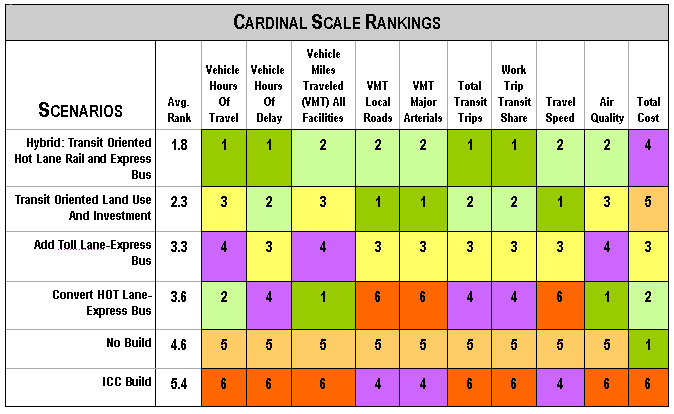
A new study conducted by Smart Mobility, Inc., a nationally recognized traffic modeling firm, has confirmed what ICC opponents have been saying all along: there are alternatives to building the ICC that will do a better job of reducing traffic, air pollution, and costs.
The study found four practical, cost-effective options that performed better than the ICC. The alternatives that performed the best included a combination of increased transit with more jobs and housing near transit, and a better east-west balancing of jobs and housing between Prince George’s County and Montgomery County. Most of the alternative elements are already under study by the counties or the state, but were deliberately excluded from the ICC study. Keith Lawton, former director of Technical Services at Portland Metro, the regional equivalent to the Washington area’s Council of Governments, reviewed the analysis and noted that “The report conclusions seem to be well justified.” He added further, “The results certainly show that a more measured analysis of alternatives . . . would be in order before embarking on construction of the Intercounty Connector.”
Neal Fitzpatrick of ANS comments that the report confirms that there are options “that perform better than the ICC for reducing traffic on local roads.” In fact, the ICC was the only alternative to increase vehicle miles traveled and vehicle trips made every day. Further, costs of the options ranged from $626 million to $2 billion, all less than the $2.1 to $2.4 billion in construction costs currently projected for the ICC. What’s more, environmental damage would be limited, acres of forests and wetlands saved from destruction, and air pollution less than with the ICC. “We analyzed air pollution and our best alternative produces less NOx air pollution by a half-million pounds a year than the ICC,” notes Lee Epstein of the Chesapeake Bay Foundation.
The report, The Intercounty Connector: Performance and Alternatives, was commissioned by Environmental Defense, Chesapeake Bay Foundation, Audubon Naturalist Society, Solutions Not Sprawl, Sierra Club, and the Coalition for Smarter Growth after the state refused to include alternatives in its ICC study. The full report and a summary can be accessed online at www.SmarterGrowth.net and www.environmentaldefense.org/go/iccoptions.
It may all come down to how much currency his “flush tax” will carry in the next election year, as Maryland Governor Robert Ehrlich tries to convince environmentally-conscious voters to remember the good news and forget the bad.
But if the results of a recent poll by the Baltimore Sun are at all representative of the will of Maryland voters, he had better pay attention to the environment, and his opponent had better capitalize on the overall record of Ehrlich’s administration.
The poll, taken among 800 registered voters, showed concern for the environment and Chesapeake Bay to be among the top four important issues that people in our area would like to see taken up in the legislature that is now in session. Ehrlich, who made an early enemy of environmentalists by proposing a pro-industry candidate to oversee the state’s department of environmental protection, has done much to show voters that he is out of step with their concerns: selling protected state lands to developers, supporting the costly and environmentally-catastrophic ICC at the expense of road improvements and transit, fast-tracking the introduction of non-native Asian oysters even though every other state and the federal government have warned of the dangers of this approach. And in the latest move, Ehrlich proposed one of the most obstructionist and anti-environmental legislators in Annapolis-Ronald.
Schools and pesticides: how well are our children being protected in Maryland?
Ten years ago, a coalition of Maryland groups got together to work on legislation to ensure that the state’s schools adequately protect children from pesticide exposure. A recent report by the Maryland Pesticide Network, the group that spearheaded the law, found that compliance is abysmally lacking, in large part due to the state’s failure to develop and implement adequate regulations to enforce the law.
Two reports-Are We Passing the Grade: Assessing Maryland Schools’ Compliance with IPM-In-Schools’ Law and a companion report that looks at the Department of Agriculture’s adherence to the law-detail frightening lapses that put our children at risk. Because they are still growing and developing, children exposed to pesticides can develop behavioral, neurological, respiratory, and even gene disorders, making it all the more important for parents to know when and to what their children are exposed.
The Maryland law-which at the time was landmark legislation unmatched elsewhere in the country-states that “pesticides are only to be considered as an option when non-toxic options” have been exhausted. Should pesticides be needed, schools are required to follow specific notification rules, including a statement warning parents of the effects of exposure to pesticides.
But instead of complying with the law’s intent, which was for pesticide use only as a last resort, the Maryland Department of Agriculture instead sent the message to schools that compliance with the law would be ensured as long as the parents were simply notified. These faulty guidelines exposed thousands of children to pesticides when less-harmful Integrated Pest Management (IPM) solutions were warranted.
The report is based on surveys sent to every school in the state to assess compliance with an IPM plan.
Sixty-nine percent of the schools that responded to the survey used pesticides on a planned basis during the survey year. In addition, a high number of schools were not aware that they needed to notify parents in the event of pesticide use, and did not have sufficient information and training to use IPM as an alternative. Some schools notified parents in inappropriate ways, such as burying a notice in school calendars or in other ways that made it easily overlooked.
The good news is that three counties-Montgomery, Anne Arundel, and Harford-passed the test of compliance with the spirit and letter of the IPM law. Montgomery County IPM supervisor Richard Stack was even quoted in the report as saying that “pesticides are, in 99% of the cases, unnecessary,” for use in schools.
Will Poplar Island become a template for Bay restoration?
We are losing the islands of the Chesapeake Bay. Erosion and silting, sea level rise, hurricanes, and many other factors conspire against the Bay’s fragile island ecosystem. One of these, Poplar Island, was once sporting ground for presidents, as well as habitat for waterbirds, turtles, and many more animals. But the past 150 years have reduced the island from 1,000 acres to less than ten.
There is some good news, however. Acting on the principle that one man’s trash is another’s treasure, the Army Corps of Engineers began in 1998 to “rebuild” Poplar Island, essentially by dumping dredged muck from the channels of the Bay and Baltimore Harbor. If all goes as scheduled, when the work is completed in 15 years, the island will consist of 570 acres of “wetlands” and another 570 acres of uplands.
Already, wildlife is beginning to use the island-diamondback terrapins nest there, and 100 bird species have been observed. Humans are attracted as well: tours from Tilghman Island are regularly scheduled by the Maryland Environmental Service. Call 410-770-6500 to arrange one.
Democrat and Republican-appointed judges rule differently on environmental issues
The National Environmental Policy Act (NEPA) is thought of as the cornerstone of our country’s environmental policy, since it requires that the environmental effects of all federal projects must be taken into consideration before the project can be approved. But an independent investigation by the Environmental Law Institute of 325 cases brought to court from 2001-04 found that judges have a solidly partisan approach to the application of NEPA.
Looking at the records of rulings for or against environmental plaintiffs, the study found that federal District Court appointees of Democratic presidents ruled in favor of the environment 60% of the time; Republican appointees ruled only 28% of the time in favor of the environment. (The current President Bush’s judicial appointees ruled in favor of the environment only 17% of the time.) And when all three judges on the federal Circuit Court level were appointed by a Democrat, the ruling was in favor of the environment 75% of the time; when all three were appointed by a Republican, the ruling was favorable to the environment in only 11% of the cases.
The report noted that the political tinkering with NEPA by the administration has been thought by some to be “a determined effort to circumvent its protections, or eliminate them altogether.” The Bush administration has actively filed 30% more cases under the law than the historical average-giving his conservatively-stacked judiciary more opportunities to chip away at NEPA protections. One example of this is in the expansion of “categorical exclusions”-broad categories of actions not falling under the law-which the administration claims are efforts to “streamline” NEPA, but many feel will instead gut its power.
NEPA was passed to help ensure non-partisan, non-political, science-based assessments that allow a reasoned understanding of environmental impacts before they become permanent. The process is supposed to be transparent, with public input its cornerstone.
Need more information about the watershed Cleanup?
It’s amazing what a group of people can accomplish in a few hours. Last year, volunteers across the region removed more than 160 tons of trash from the Potomac River watershed. For questions about the cleanup, roles of the site leader, and locations of cleanup sites near you, please visit the Alice Ferguson Foundation’s website at www.potomaccleanup.org and follow the link to the “Potomac Watershed Cleanup”.
Call or e-mail any of the following members of the Fairfax Watershed Network:
Stella Koch, Audubon Naturalist Society
Virginia Conservation Associate
703-669-3922 [email protected]
Laura Grape, Fairfax County Department of Public Works and Environmental Services
703-324-5500 [email protected]
Diana Saccone, Watershed Manager
Reston Association
703-435-6560 [email protected]
Remember every extra set of hands, no matter big or small, helps! Let’s get our streams trash free!
What’s the #1 pumpkin growing county in Maryland? Read on . . .
This year marks the 25th Anniversary of Montgomery County’s Agricultural Reserve, an innovative and nationally acclaimed farmland and open space preservation plan that includes 90,000 acres in the northwestern third of the county. ANS has long been involved in protecting the Ag Reserve from suburban infiltration, and to celebrate our success and the Reserve’s precious rural character, we have joined with numerous other organizations to form Celebrate Rural Montgomery. Long-time ANS member and author Melanie Choukas-Bradley is serving as Programs and Education Director for the anniversary celebration.
Through a series of events over the next year, Celebrate Rural Montgomery will draw attention to the bounties of the Ag Reserve, as it is affectionately dubbed by its admirers, and how all county residents benefit from its protection. Among its attributes: clean air, clean water, stunning rural scenery including the landmark Sugarloaf Mountain; a multitude of recreational opportunities such as horseback riding, hiking, canoeing, fishing; diverse historic sites; and a wealth of fresh fruits and vegetables that are available throughout the county at pick-your-own orchards, farm stands, and farmers’ markets.
Did you know that Montgomery County is the # 1 pumpkin-growing county in the state? And that it ranks # 2 in berry growing? And that its farms and horticultural enterprises contribute $252 million to the county’s economy annually?
For additional information, check out Celebrate Rural Montgomery’s website, www.ruralmontgomery.org.
Some hope offered for homeowners in battle against deer
The white-tailed deer population in the Mid-Atlantic states is probably greater now than it has been at any time in the past 300 years. The disappearance of predators and the creation of edge habitat that deer love-a result of our agricultural and residential land-use patterns-have created a wonderland for them to procreate, recreate, and eat.
This is not good news for homeowners, gardeners, public land managers, or those who make their living by growing plants. Homeowners who live close to deer habitat quickly discover that their hostas, lilies, yews, arborvitae, and fruit trees are deer candy. Deer browse of woody and herbaceous plants in natural areas, which can lead to reduction in recruitment of subsequent generations of native plants and create opportunities for establishment of invasive species, is a too familiar phenomenon. Astute gardeners know that using plants that deer don’t like can discourage browsing, but a really hungry deer will eat almost anything.
An article in the Summer 2004 edition of People Places Plants magazine reports that studies at several universities suggest that smell- or taste- repellent products are effective deer deterrents if applied before deer have begun to browse. Use of such products requires patience and persistence, and many may need to be applied several times a season. That fact alone makes repellents impractical for use by natural resources managers.
Rob Gibbs, a wildlife manager for the Maryland-National Capital Park and Planning Commission, must deal with deer predation issues throughout most of Montgomery County’s 32,000-acre park system. “Repellents are impractical to use as deterrents for the large land areas we must manage,” says Gibbs. “They might be useful where we are trying to protect concentrated populations of RTEs (rare, threatened, or endangered plants), although fencing is our usual approach.”
Carole Bergmann, M-NCPPC’s forest ecologist and Gibbs’ colleague, has supervised reforestation projects in county parks since the early 1990s. She believes that using repellents on thousands of trees is impractical and instead has employed plastic tree shelters (such as Tubex) or, more recently, small wire cages to discourage deer browse. The Maryland/DC chapter of The Nature Conservancy (TNC) is currently experimenting with planting twice the number of trees in reforestation areas rather than use Tubex. “Use of repellents was never an option,” states Deborah Barber, Director of Land Management at TNC’s Bethesda office.
But what about homeowners? Maryland Cooperative Extension Bulletin 354, “Managing Deer Damage in Maryland,” offers some basic principles:
Repellents do not eliminate browsing, only reduce it.
If minimal damage (up to 25% browse per plant) is not acceptable, consider using 8-foot plastic fencing or bird netting over individual shrubs or small beds.
All repellents will require reapplication; 5 to 6 weeks of protection is the limit for any product when there is high browsing pressure.
Begin using repellents in spring or late fall, when deer establish their winter feeding habits.
When food is scarce, deer will ignore any type of repellent.
Experiment with different types of products to see what works best for your situation. Learn the active ingredients of repellents, not just their trade names.
Alternating two or more products will keep deer confused and wary; they become accustomed to repeated use of a single product.
Clearly, no product is going to solve all problems. Tests have shown that odor-based repellents outperform taste-based products. A study conducted from 2000 to 2002 in Montgomery County found that deer browse was reduced from 49% on untreated plants to 12 to 26% on plants treated with a variety of deer repellents. Most effective were those that used blood or fish by-products, garlic, fertilizer, smelled of rotten eggs, or included a chemical called denatorium benzoate (aka Bitrex) as the active ingredient. People Places Plants suggested alternatives in addition to fencing, such as motion sensing sprinklers that fire a heavy stream of water, Milorganite-a sewage treatment by-product that is sold as a fertilizer, hot pepper wax combined with coyote urine, deodorant soaps, and systemic pellets. This last product (see www.deerbusters.com) is absorbed into the roots, stems, and leaves of plants. The deeply bitter taste it produces reportedly lasts for three years.
Homeowners and gardeners may find that using plants that deer don’t like is the lowest impact approach. Lists often include non-native plants that may escape cultivation and cause severe problems in natural areas (e.g., Japanese barberry, European privet, and common buckthorn). Better choices include shadbush, spicebush, paper birch, native vining honeysuckle, lilac, coneflower, columbine, and lily-of-the-valley.






 This is not good news for homeowners, gardeners, public land managers, or those who make their living by growing plants. Homeowners who live close to deer habitat quickly discover that their hostas, lilies, yews, arborvitae, and fruit trees are deer candy. Deer browse of woody and herbaceous plants in natural areas, which can lead to reduction in recruitment of subsequent generations of native plants and create opportunities for establishment of invasive species, is a too familiar phenomenon. Astute gardeners know that using plants that deer don’t like can discourage browsing, but a really hungry deer will eat almost anything.