


Crowder-Messersmith Conservation Fund
Current Recipients | Past Recipients | Apply | Instructions
Donate
To donate, click here, and choose “Crowder-Messersmith Conservation Fund” under “Designation.”
The Fund honors Orville Crowder and Don Messersmith, two leaders in nature tourism, as a means to further global nature conservation. The Crowder-Messersmith Conservation Fund, together with the Audubon Naturalist Society (ANS) nature travel program, allows ANS members to experience and promote other cultures and environments and to help promote conservation awareness and protection beyond the United States. The fund helps small, local conservation and/or education projects in developing countries. Its grants provide seed money to communities and individuals whose projects have not attracted major support from other sources.
Grants have provided more than 75 projects with start-up costs since 1974. ANS has administered the Fund since 1999. In 2011, the Fund supported projects to help protect and preserve endangered species in Oceania, Africa, and Asia. Two of the species that benefited from the grants are listed by the IUCN as near-threatened; the third is critically endangered.
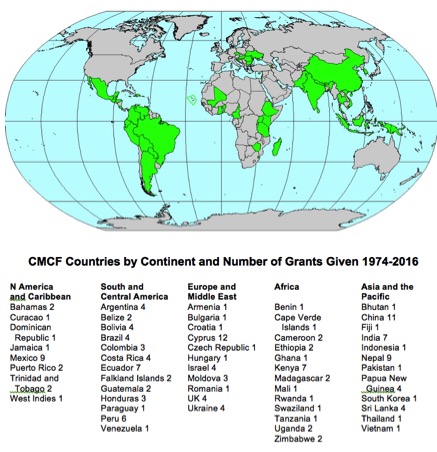
| Crowder-Messersmith Grantee Countries 1974 – 2016 |
 |
The ANS Crowder-Messersmith Fund Committee recently awarded four 2015 grants for conservation education.
- The Timbaktu Collective in India received a grant to provide conservation education to the local impoverished communities in the Anatapur District of Andhra Pradesh. The Indian wolf (Canis lupus pallipes) is severly threatened and many are found outside of protected areas. By providing “Wolf Walks” to approximately 2000 children ages 9-13, the Timbaktu Collective hopes to increase conservation knowledge and nature appreciation an rural communities.
- Green Age NGO received a grant to study and protect the Armenian Whyskered Bat (Myotis hajastanicus) in the central northern Gegharqunik Region of Armenia. the project will identify the habitat area (including breeding caves and ranges), determine threats to habitat, and define potential protective measures. Local participants, zoology and biology students, and Sevan National Park Authorities will be trained in monitoring and protection. This was our first grant in Armenia.
- In Benin, the Laboratory of Applied Ecology, Faculty of Agronomic Sciences, received a grant to train students, locals and forest rangers in the protection of the vulnerable species of African mahogany (Khaya senegalensis). Participants will be trained in growing seedlings, planting, and monitoring the seedlings in the district of Atacora in northern Benin. This was our first grant in Benin.
- Technology Aid International in Uganda was awarded a grant to produce a short comedy film highlighting the importance of African elephant conservation. Illustrating the tourism, medicinal, and industrial community benefits of the African elephant and its habitat, the film is intended to be both entertaining and educational. It will be in English and two indigenous languages, available in a wide variety of applications, such as YouTube and and bluetooth. It will also allow for feedback and for further information on this vital resource.
- In 2014 a grant was awarded in support of the recovery and conservation of the Ethiopian Wolf, an Ethiopian endemic with a population of approximately 450. The project generated new knowledge on the status and ecology of an unstudied wolf population; developed and implemented innovative community–based wild life conservation; increased awareness of the wolf’s conservation needs by the local people; and developed community-based conservation education.
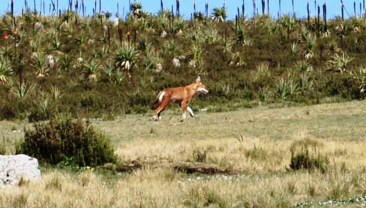 Ethiopian Wolf
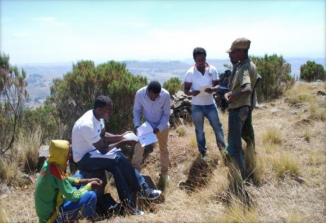 BSNP Survey
- Also in 2014, the Environmental Governance Institute (EGI) in Cameroon was awarded a grant that protected cross-river gorillas (critically endangered), mandrills (vulnerable), and African forest elephants (endangered) through the education of communities around Takamanda National Park, carried out conservation education targeting hunters, wildlife traders and youth and focused on the rights and responsibilities of communities with regard to conservation. Throughout the project EGI worked closely with government wildlife protection agencies to strengthen wildlife monitoring and enforcement of laws.
- A small group of dedicated Cape Verdians on Santiago received a grant for their project to rehabilitate, protect, and support eco-touristic use of beaches, lagoons, and the surrounding areas. Many of the island beaches are used by the critically endangered Leatherback Turtle, and the lagoons are important refuges for migrating shorebirds of conservation concern.
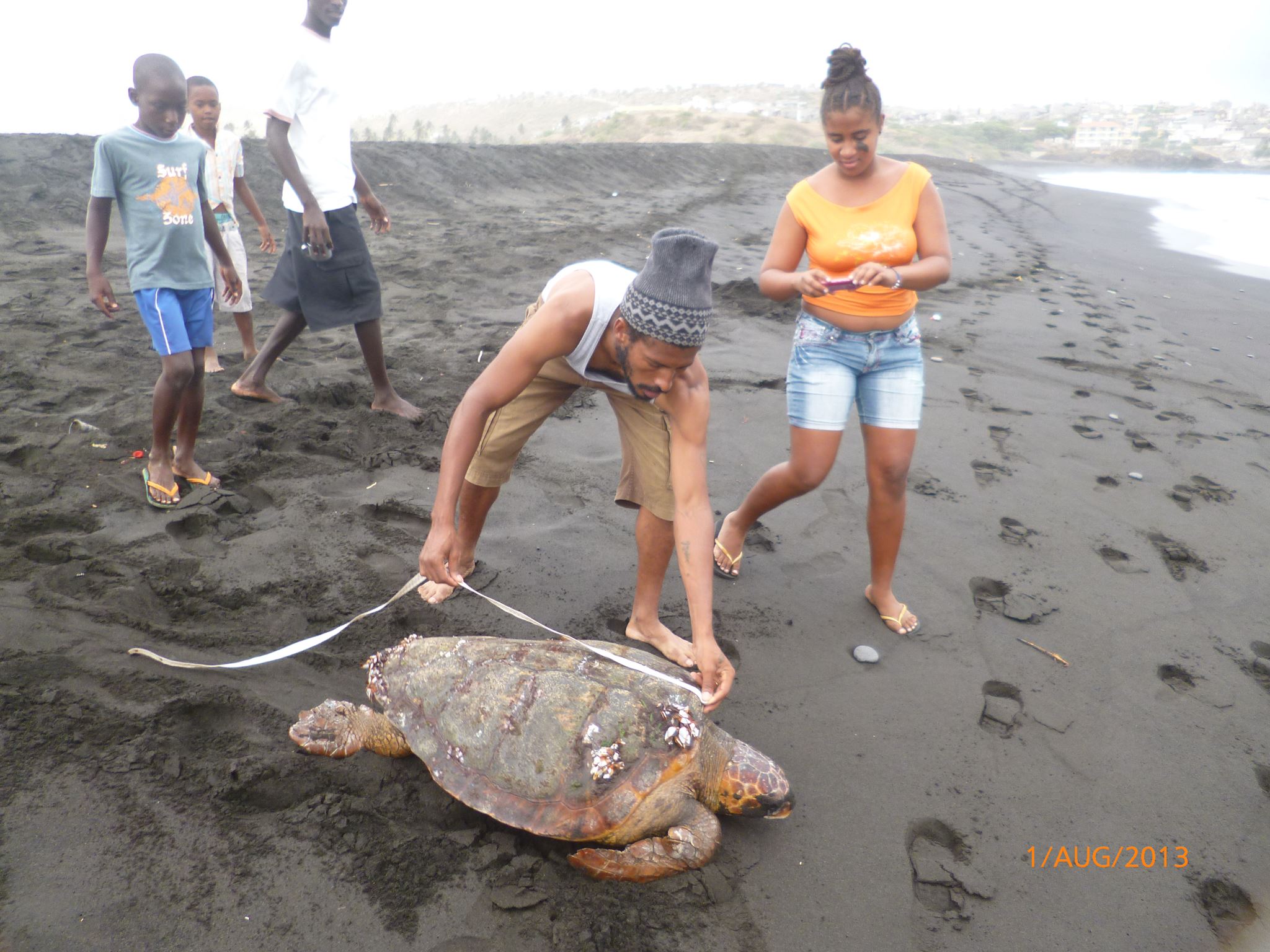 |
| Leatherback Turtle |
- Mr. S. P. Anandan of the Foundation for Research and Sustainable Development in Madurai Tamil Nadu, India. Anandan studied fruit-eating and insectivorous bats, particularly the Salim Ali Fruit Bat (Latidens salimali) in the Western Ghats Mountains. The work involves conservation education programs for school students, indigenous communities, farmers, mountain people, and estate owners. The purpose of these programs is to convince these targeted groups of the necessity and methods for protecting the bats’ natural habitats (caves, large trees, temples, etc.).
- Ms. Emily K. Lind of the Ceiba Foundation for Tropical Conservation, Ecuador. As part of a larger project to survey birds in Ecuador’s dry forest coast, the Crowder Messersmith Conservation Fund provided funds for printing and distributing laminated bird identification cards to local youth groups, particularily in Tabuga, Camarones, and Jama. The cards were distributed to schools and businesses in the area and will serve as a resource for local naturalist guides.
If you wish to apply, please click on the link for instructions
and an application form (PDF version).
— Carol Hayes, Crowder-Messersmith Grant Administrator
APPLICATION Information
Preference is given to projects that will benefit human, plant and animal communities of a particular habitat in an ecologically sustainable manner. Projects must have:
1. a benefit to the human, plant and animal populations of a particular habitat in an ecological sustainable manner
2. a lasting significance to local residents
3. protect threatened or endangered species or habitats
4. a public education component.
The Project must:
1. be outside the United States or other developed country
2. involve the local population
3. if research, just be for conservation purposes rather than to obtain scientific data
4. funds must go for salaries, material and publication development, meeting and training costs, field trip costs and not international travel or overhead expenses, taxes, utilities or insurance.
Preference is given to applicants who have a record of prior conservation action relevant to the proposed project. Applicants from countries other than the United States are especially encouraged to apply. United States researchers planning work in foreign countries must have at least one local collaborator and consider how the project will benefit the local communities.
Application Time Frame
Applications are accepted beginning Septemeber 1, 2016. Deadline for receipt is December 15, 2016. Decisions will be announced in March, 2017.
Maximum Grant Amount
The maximum grant for 1 year is $2000.
Grant Acceptance
Upon Notification of a grant award, the Grantee must provide bank information for an international bank transfer. The Grantee must also agree to provide a project status report half way through the project. Upon completion of the project, but no later than November 30 of the same year, a full project report is required. This report must include an accounting of funds, a description of activities and populations receiving education and/or training, copies of any materials or publications that have been developed, and photos of project activities.
Instructions for Preparing Grant Applications
Where to Send
Email your application as an attachment to: [email protected]
or mail to:
Crowder-Messersmith Conservation Fund
Audubon Naturalist Society
8940 Jones Mill Road
Chevy Chase, MD 20815
USA
On the subject line of the email transmitting your application use a title that is a concise version of your project title. The transmittal email is a good place to describe your relationship with the organization requesting the funds.
Document Format and Length
The entire application must fit on four pages or less. There are no limitations on the space devoted to individual sections. The application should be in Times Roman 12 pt type. The document may be in MS Word (*.doc or *.docx), pdf or rtf formats.
Name and Email of Requester
This should be the person responsible for preparing and transmitting the proposal, not the local field manager carrying out the work. We will communicate only be email. You may include a mailing address and phone number if you wish.
Organization
Grant funds will be transferred electronically so successful applicants will need to provide a bank account number of the organization where you work. Checks will only be written and mailed in rare instances in which a bank transfer is not possible.
Title
The title should include the specific activity being proposed “conservation”, “training”, etc. are too vague. Please include the species or habitat that the effort is directed towards (use common name), also include the location – country and area.
Summary
It is not necessary to go into a lengthy discussion of the location and species. The selection committee is primarily interested in the specific details of what you are proposing to do with the funds you are requesting. Please state the school/education program, community and populations that will be served. If you are trying to educate local communities, perhaps to stop hunting/poaching, how specifically are you going to do it? If you are doing plant/animal surveys how are you involving the local community and how will they benefit from your activities?
Budget
The more detail you provide the better. If you are also receiving funds from other sources for this work please state what they will be providing.
Relation to Previous Work
Our website states that “Preference is given to applicants who have a record of prior conservation action relevant to their proposed project.” This is the place to concisely discuss your record and how it relates to the proposed project. Remember there is a four page limit on the total application length. Some applicants have been submitting a resume or curriculum vitae as a separate attachment. This is not necessary.
How Did You Hear About the Crowder-Messersmith Conservation Fund?
We are interested in knowing how your organization heard about the grants awarded by the Crowder-Messersmith Fund.