Linda
Lear, author of the prize-winning Rachel Carson: Witness for Nature,
has produced another fine biography of a notable woman whose life bridges
the 19th and
20th centuries:
Beatrix Potter: A Life in Nature. It is another happy marriage of
scholarship with good writing.
At
474 pages, this is no small book and with good reason, for Potter’s life
encompasses many things besides children’s literature. Indeed, this biography
has something for everyone. Potter’s personal history is in itself a moving
story of a woman’s struggle to escape the isolation and dependence of an upper
middle class Victorian home. Educated at home by nannies and governesses, her
artistic abilities were recognized early on, and she joined her lawyer father
in sketching and photographing nature. Her artistic talent developed and, at
30, she became financially independent as the successful writer-illustrator of
Peter Rabbit and, at 39, she gained a measure of personal freedom from
her parents by purchasing a Lake District farm. After the tragic death of her
first love, she fell in love again and married at 47, over her parents’
objections, by which time she was becoming a community leader, a major
landowner, and an important preservationist. The recently released movie
Miss Potter brings these personal aspects of Potter’s life to the
fore.
Those
of us who as children loved Peter Rabbit and the other Potter books
will delight in discovering charming ways that they came about and their
relationship to Potter’s everyday experiences in the country and, in later
life, on her farm.
The
literary and artistic among us will learn from Lear’s analysis why these books
have endured so well. In addition to the obvious virtues of superb
illustrations and enthralling stories, Lear points out deeper qualities: “In
The Tale of Peter Rabbit, Potter achieves a seamless harmony between
animal and human nature.” And, speaking of Potter’s transformations of
Aesop’s Fables, “…no matter how beautiful the illustrations, the
landscape is real, the animals are anatomically accurate, and the plants are
planted correctly. It is a triumph of fantasy rooted in fact.” Lear observes
that Potter correctly saw and communicated the foibles and flaws in both
animal and human natures.
Lear
treats several significant social and historical themes: the situation of
women in English society; the relationship of amateur and professional
scientists; the state of English agriculture and the changes brought about by
mechanization and by WWI; and the preservation of scenic landscapes,
traditional architecture, breeds of livestock, and the rural life in England’s
Lakes District.
A
Life in Nature contains many of Potter’s color and black-and-white images
and many photographs, which illustrate her life. They are a well-chosen
accompaniment to Lear’s text. Purchase this book online through the Audubon Sanctuary Shop at a 25% discount.
Sick of Nature
By David Gessner
Dartmouth College Press, 2004
Why would David Gessner, acclaimed author of Return of the Osprey: A Season of Flight and Wonder, open his new essay collection complaining, “I am sick of nature. Sick of trees, sick of birds, sick of the ocean”? Eschewing expectations turns out to be one of Gessner’s favorite pastimes, as he exuberantly demonstrates throughout Sick of Nature. He expresses as much passion for Ultimate Frisbee as for hiking in the Belizean rainforest and reveals intense grief for both the bulldozing of a favorite Cape Cod beach and the loss of his brother’s mental health. By ranging so widely, Gessner prods readers to rethink our definitions of “natural” and dares nature writers to reject the constraints of the genre.
After all, he’s not sick of nature itself but of somber, pious, and preaching-to-the-choir nature essays. Gessner prefers “thorny, uncategorizable writing,” and asks, “Why not let farce occasionally bully its way into the nature essay? Or tragedy? Or sex?” The artist in Gessner rails in “Soliloquy on Spartina” that the shrinking boundaries of the genre are domesticating away its virtues. “Dullness,” says Thoreau, “is but another word for tameness.” Gessner’s activist soul rages against the ineffectiveness of literary paeans to vanishing wildness. If asked to battle developers on Cape Cod, he laments, most of his colleagues would “take to the beaches to wander, alone and aimless, in search of terns and profundities.”
Critics often compare Gessner’s iconoclastic style with Edward Abbey’s. Like Abbey, he wants readers to laugh at human nature at least as often as they celebrate natural wonders. And as with his monkey-wrenching predecessor, you may not be sure when Gessner is telling the literal truth and when he’s imagining a more poetic one (did he really protest construction of a neighbor’s trophy home by marking his territory, coyote-style?). But he can also write gently, as when he tracks a coyote through Boston bacyards or awaits the birth of his child. Anyone who can capture in words the quiet joy of rocking an infant as well as the boldness of an osprey’s plunge to the sea is a unique voice, well worth reading even if you’re not the least bit sick of birds and trees.
— Julie Dunlap
Tracking Desire: A Journey after Swallow-tailed Kites
By Susan Cerulean
Univ. of Georgia Press, 2005
In her latest offering, Florida-based naturalist Susan Cerulean weaves personal growth tales through the deeply important story of a species on the edge. In her pursuit of swallow-tailed kites, arguably North America’s most graceful and beautiful raptor, Cerulean follows preeminent kite researcher Dr. Kenneth Meyer into the field. Together, they fly over Florida’s great Fisheating Creek roost site of about 2,000 birds and search for nesting kites in the Everglades and elsewhere in south Florida. She joins Meyer as he and his team band and radio-tag some of the young hatchlings. Throughout, she makes the reader aware of the tenuous status of this seriously endangered bird.
Cerulean has been speaking out against environmental crises in Florida and beyond for years. Here, she writes, “… our modern intimacy is with our human culture and its virtual realities, not the living planet of which we are simply a part … We see ourselves apart from, so independent of the living planet we inhabit. Such separation robs us of the rich contributions the rest of the living entities might offer our often troubled selves.”
While the material on the life habits and survival struggles of swallow-tailed kites is rich and engaging, the same cannot be said of Cerulean’s recounting of childhood memories and her growing awareness of the natural world and her place in it. This is an uneven and questionably relevant part of her story. Even so, the book is well worth reading.
— Donald Sweig
Hawks from Every Angle: How to Identify Raptors in Flight
By Jerry Liguori
Princeton Univ. Press, 2005
Another in an increasing number of raptor photo guides, Hawks from Every Angle will help identify flying raptors anywhere, though it will prove most useful at migration concentration points, such as mountain ridges.
Jerry Liguori, a well-known and respected hawk watcher and migration counter, has experience at major Eastern and Western raptor migration sites, and his book draws on his years of experience in identifying raptors in flight. Liguori is also an excellent raptor photographer. He combines his experiential knowledge with photos of flying raptors in a unique manner to enable both amateur and experienced hawk watchers to better identify what they see flying by.
Liguori uses his color photos to “present plumage traits,” and the black and white photos to “depict shape characteristics.” His text is clear and genuinely helpful. Important points are put in bold type, and he discusses not only what flying raptors look like, but how they fly as well. He groups taxonomically different birds, such as turkey vultures and zone-tailed hawks, together because that is how they are often seen and confused in the field. He includes maps of major fall and spring raptor migration sites. This is a book to read before one goes to look at raptors—and to take into the field. Highly recommended.
— Donald Sweig
Don’t forget—young readers love to discover nature, too!
We are lucky this season to
find three new books for children
that feature well known early
conservationists. These leaders are
wonderful role models for budding
naturalists.
Rachel Carson: Preserving a Sense of Wonder
By Thomas Locker and Joseph Bruchac.
Fulcrum Publishing; 2004. 32pp. Hardcover $17.95
Rachel Carson is the stunning
third book in Locker’s series
on conservationists. This
lyrical tale follows Rachel’s childhood
love for songbirds through her
work as a biologist and her
groundbreaking environmental
writings that changed the world. The
book is lavishly illustrated and
sensitively written for young
children.
The Story of John James Audubon
By Jacqueline Davies. Illustrated by Melissa Sweet.
Houghton Mifflin Co., 2004. 30 pp. Hardcover, $15
When John James Audubon was a young
boy, his fascination with birds made him
want to learn more about their unexplained
disappearance each winter. Many scientists believed that birds spent the
winter clinging together in large balls underwater, but John had never seen such a
bird tangle and did not believe this was the correct explanation. In the fall of 1804
he decided to try to determine if the same small birds nesting near his home would
return the following spring. This book tells how he pioneered the technique of bird
banding and discovered that his local peewees did in fact return each year. The
story provides a charming introduction to ornithology for young children and
encourages them to ponder the mysteries of the natural world.
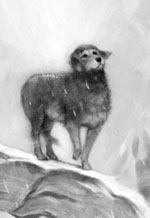
John Muir and Stickeen: An Icy Adventure with a No-Good Dog
By Julie Dunlap and Marybeth Lorbiecki.
Illustrated by Bill Farnsworth.
North Wood Books for Young Readers, 2004. Hardcover, $16.95
John Muir, an early naturalist and
wilderness explorer, had a deep
appreciation for wilderness and all
wildlife, but not pets. During the
1880s, on an expedition to Alaska, an
expedition member brought along
Stickeen, a friendly mongrel to which
Muir objected. One morning when Muir
set out to explore the glaciers around Glacier Bay,
Stickeen decided to accompany him. Muir tried to dissuade the pup
to no avail.
This story tells of their
perilous adventure—
Stickeen’s
bravery that day
on the windswept,
icy slopes forever
changed John
Muir’s opinion of
Stickeen, the “No-
Good Dog.” This
fascinating, true
story will appeal
to all children
who love dogs and the great outdoors.




 John Muir and Stickeen: