Imagine driving from Washington
west across Maryland to the hills of
West Virginia. Sprawling suburbs
give way to rural towns, farms give way
to sprawling, forested mountain slopes.
The countryside’s huge coal fields are
carefully hidden from view, but this is
not: a string of towering, gleaming white
wind turbines, lining the mountains’
ridgeline like vertebrae.
Whether you see these as an
eyesore—one West Virginia newspaper
called them “no better than billboards,”
or a symbol of the battle against global
warming, is up to you. But one thing is
clear in many minds: no matter how you
feel about wind energy, our dependence
on electricity from coal has to stop. From
blasting off the top of mountains (and
using stream valleys to contain the
rubble) to the old, sooty, acid-rain
producing smokestacks used to burn it,
electricity produced by coal is bad news
for everyone.
Nearly half of our nation’s electricity
is fueled by coal, and our increasing
hunger for power could result in as
many as a hundred new coal-fired power
plants spread across 36 states—at a cost
of nearly 50 percent more greenhousefueling
CO2 emissions. Along with these
plants come a host of other problems,
both global and local: sulfur dioxide
(68% of the nation’s total sulfur dioxide
pollution was from coal-fired power
plants in 2001), and heavy metals—
notably mercury—in the air; huge slag
heaps that destroy mountain stream
ecosystems; entire landscapes in which
small towns sit powerless at the hands
of huge, federally-blessed coal interests;
countless deaths from injury and
exposure to toxic by-products. And these
are just the human tolls.
Birds are killed on power plant
smokestacks—3,000 on one night alone
at ONE power plant in Florida. Coal
extraction has destroyed 380,000 acres of
eastern forest habitat for birds like the
cerulean warbler and others in the past
10 years, according to the American Bird
Conservancy; that same amount will be
lost again in the next 10 years if our
dependence on coal continues, as it’s
likely to do in the face of population
growth projections.
For decades, environmentalists
have been calling for an alternative to
this energy picture—a decentralized,
sustainable energy future that relies on
renewable energy sources rather than
fossil fuels. At last—with the cost of
relying on foreign oil, the public outcry
against the current Administration’s
concessions to dirty energy industries,
mounting concerns about global climate
change, and technical advances that
increase output and decrease cost—at
least one renewable may be ready to
make a dent in our energy supply: wind.
There are currently 16,000 wind
turbines in the US—mostly in
Western states with wide-open
landscapes or in California, which is
historically ahead of the game in
adopting environmental technologies. In
addition, more than 14 states have
renewable energy portfolio standards
which require a mix of renewable
sources in the state’s energy purchases.
This enforced demand—along with
lucrative tax breaks and financial
incentives—has the wind energy
industry ready to match a steady supply
of wind with a steady and growing
hunger for electricity.
According to a Mother Jones
article in the summer of 2002, technical
advances and economies of scale, in
addition to lucrative tax incentives, have
made wind competitive: three to six
cents per kilowatt hour, as opposed to
two to five cents for conventional fuels.
These savings are in part due to the
availability of technology capable of
ramping up turbine size to industrial
scale and taking advantage of relatively
steady wind speeds in places like
mountain ridge tops. (Offshore wind
energy, although popular in Europe,
seems stalled in this country over the
issue of offshore scenic vistas.) And
wind, placed in the right location, is far
more predictable than foreign oil, the
article argues.
The race to wind energy can
hardly be characterized as swift,
however, or even new for that matter.
In the 1880s, more than 1,000 working
wind turbines brought power to mills,
farms, and families on Cape Cod; by
1930, the world’s largest turbine was
operating in Vermont. By 1985, California
responded to perceived future energy
shortfalls by hastily constructing 1,000
megawatts of wind capability at
Tehachapi and
Altamont passes.
By
1990, the state
produced half the
world’s capacity of
wind energy; by 2000
this lead had slipped,
replaced by the
European Union
(mostly Germany and
Spain). Although
many factors have
stalled the wind
energy industry’s
takeoff—not the least
of which is the heavy
influence of the coal
extraction and power
plant industries—one additional factor
may have been involved: the wind farm
in California’s Altamont pass was
critical migratory habitat for golden
eagles, proving disastrous implications
for raptors. Mortalities are still high at
this site: its old-design turbines—fast
moving, supported by wire structures
that confuse and trap birds, and illuminated
by lights that attract them—have
to some extent been re-tooled, but many
feel that the site is simply wrong. A
recent study prepared for the California
Energy Commission on reducing avian
mortalities at Altamont found that, in
part because they fly at lower heights
and are more subject to collision
between 881 and 1,300 raptors are still
killed each year at Altamont, including
75 to 116 golden eagles. Other raptors
affected include red-tailed hawks,
American kestrels, and burrowing owls.
Complicating the picture is the presence
of a steady population of ground
squirrels—raptor prey—that make their
homes in the rock piles created from
turbine construction.
As they say in the real-estate
business, location is everything.
Now that the country seems poised
to consider adding wind energy
as a meaningful component to
our energy resources, it is crucial to
ensure that we learn from mistakes.
“There is a lot we do know about
making wind turbines compatible with
birds,” remarks Gerald Winegrad, Vice
President for Policy at the American
Bird Conservancy (ABC). “Lighting,
proper support structures, decreasing the
footprint of these
sites can all go a
long way in lessening
the effects of
wind turbines,”
particularly in
relation to other
forms of energy.
Winegrad,
who spearheaded
the Wind Energy
Policy for ABC, is
an unapologetic
opponent of what he
calls “Big Coal,” and
is hopeful that wind
can, at least in small
part, offset its
effects. “If you go into Appalachia and
see how carelessly and callously coal
companies treat the countryside, and
how this policy causes incredible losses
in habitat, streams, and even entire
mountaintops just to feed our coal
consumption—the cost is amazing and
depressing. We need to look at the big
picture,” he goes on, “at how we’re going
to feed our incredible hunger for the
electricity that supports our lifestyle,
and not kill people, and birds, and bats,
and other creatures doing it.”
Winegrad knows of what he
speaks—he has sat for years on task
forces to evaluate risks to birds from all
kinds of man-made structures, but
particularly from communications
towers. He feels that the wind industry,
unlike others that have refused to make
concessions to save birds, works hard to
preserve its ‘green” image. He cites the
communications industry as one of the
worst offenders: their 70,000 towers
continue to kill 50 million birds each
year, even though measures can be taken
to prevent these losses. “Studies done at
Mountaineer, for example,” he says,
citing a plant that resulted in the loss of
475 bats during one bad weather event
and thousands more on subsequent
nights, “did more to help us understand
migration research and mortality than
an entire decade of work by the telecon
industry.”
The bat mortality incident pointed
to how little is known about the ways
bats migrate and behave, particularly
around wind turbines, and a coalition of
wind energy representatives, government
agencies, and Bat Conservation
International (BCI) has hired a full-time
biologist to better understand bat interactions
before its too late to take remedial
measures. Merlin Tuttle, president of BCI,
worried in the Summer 2004 issue of Bats
magazine that bat loss may prove huge if a
buildup of wind energy were to occur. “If
the kill rates from the 44 turbines at the
Mountaineer site were scaled up to the
proposed level of 410 turbines planned for
Appalachian ridges, the turbines alone
could kill more than 30,000 bats in a single
season,” he wrote.
Little is known about large scale
effects of a buildup of wind energy on
the mountain ridges of the East, and
many worry that casting our fate to
wind [energy] may have catastrophic
effects on wildlife. Although, as ABC’s
policy statement reminds us, “all energy
choices have implications for birds,”
understanding what those implications
are, and mitigating them as much as
possible before industrial scale wind
investments are made, seems the
prudent course.
Optimism that wind energy and
wildlife can coexist on the mountain
ridges of western Maryland is not
universally shared, however, in part
because the windy ridges that make
wind power so successful are also what
fuels migration. According to Chan
Robbins, author of Birds of America and
Birds of Maryland and DC, as well as
the Atlas of the Breeding Birds of Maryland
and the District of Columbia, nearly
all the hawks and eagles that nest in the
northeast US and Canada migrate through
the western portion of Maryland.
“We have no clue as to how many
birds will be killed by wind power, ”
Robbins worries, “and relying on
industry data is not the best way to
know.” The real implications, he worries,
could be ten, a hundred, even a thousand
times current estimates—but without
scientifically supported studies, we just
don’t know.
The dangers of wind energy to
migrating birds—not just
raptors but songbirds as well—
are currently being played out all along
the ridges of the Maryland/Pennsylvania/
West Virginia Appalachians, where
proposals for upwards of 700 individual
turbines are in various stages of development.
And perhaps nowhere are the
complexities of wind power, and its
political and biological pitfalls, more
evident than with the Synergics Energy
proposal to build 20 to 23, 380-foot tall
wind turbines on Backbone Mountain in
Garrett County, Maryland.
Follow Backbone Mountain’s west
side, and you’ll find a mostly green
swath of largely contiguous secondgrowth
forest—a canopy at times so
continuous as to provide enough habitat
for the state-endangered mourning
warbler—in fact, the only confirmed
nesting area in the state, according to the
Atlas of the Breeding Birds of Maryland
and the District of Columbia. But the
mountain’s eastern slope offers a
completely different story—a bleak
terrain littered with mountains of coal
slag, a denuded landscape where once
lay continuous forest habitat.
To lay the groundwork for the
Roth Rock project—so named for its
proximity to the Roth Rock fire tower—
Synergics applied for a permit with the
Maryland Public Service Commission,
and hired Paul Kerlinger, former
director of the Cape May Bird Observatory,
to prepare an Avian Risk Assessment.
Kerlinger has worked for a
number of wind industry companies, and
his research has lead to controversy—
birding groups, including the Maryland
Ornithological Society’s policy committee,
conservation biologists, and others
have found inconsistent statements,
conclusions unsupported by hard data,
and a tone that downplays the impact of
wind development and therefore undermines
the legitimacy of his studies.
Chan Robbins noted in response to
the report Kerlinger did for the Clipper
Windpower project in Oakland, Maryland,
that Kerlinger “grossly misrepresented
the threat to migratory birds,”
ignoring and underestimating vital
migratory data on the use of ridges by
both raptors and songbirds. “Kerlinger
writes that night migrants do not follow
ridges, for example,” Robbins said, “well,
that’s just not true.” Other statements—
that the effects of habitat fragmentation
are unknown, and that migration numbers
are inconsequential, are simply misleading,
he notes. Robbins calls for “good,
independent studies” to counter our
present reliance on industry information.
Kerlinger’s Avian Risk Assessment
for the Synergics plant at Roth
Rocks was based on, using language
from the document, a literature search,
interviews, and two days of observation
in mid-July, 2003 (mid-July is not
migratory season for any of the birds
that should have been studied, and
understanding the avian use of the site
during migration and nesting seasons is
paramount to assessing the impact of the
project). The report’s broad and unsupported
claims—“no federally listed
species were found on the site” (in spite
of an attached letter from U.S. Fish and
Wildlife Service (FWS) and the Maryland
Department of Natural Resources
noting concern for Indiana bat populations
and 14 species on the State concern
list, as well as the possibility of forestinterior
nesting birds that would be
affected by habitat fragmentation); and
“there will be little impact on raptors;” that
“most birds change direction when they
see turbines and fly around them,”—did
little to comfort those with concerns about
bird/bat/wind interactions.
Site-specific information is crucial
to good siting decisions for
wind—although the Roth Rock
site in no way compares to the scale and
raptor concentration at Altamont, it is
still important to better understand the
key issues in siting on ridgetops and
avoid irreversible mistakes. But instead
of calling for more studies, as is suggested
in guidance documents for wind
facilities developed by the National
Wind Coordinating Committee (an
association of wind energy companies
and others), the American Bird Conservancy,
and the U.S. Fish and Wildlife
Service, Kerlinger’s assessments
presume that if you don’t see it, it isn’t
there. He writes: “few raptors collide
with turbines during day migration,”
without providing the behavioral studies
to support the statement, and that “the
morning flight of songbirds is thought
by some to be significant, but there is no
evidence to support this,” refuting the
evidence of highly respected ornithologist
Chan Robbins instead of calling for
further observation to determine if, in
fact, there might be a problem. (The
claim is that migratory songbirds
depend on ridgelines as they fly low at
dawn—within range of turbines—in
search of roosting places.)
Further,
Kerlinger points to results of assessments
(his own) at other wind industry
projects for more information on how
risk will be played out at Roth Rocks,
ignoring the need for site-specific
studies to assess each individual project.
In fact, he writes that sites like Roth
Rocks are “nearly identical” to other
projects like the Mountaineer facility,
and that information from the study of
the Allegheny Front Ned Power installation
should be used to answer questions
about Roth Rock.
His risk assessment also contains
inconsistencies, for example, noting that
“no parks or protected land or sensitive
areas are nearby”—on the same page
that he lists Monongehela National
Forest, which is three to four miles away.
Although he calls for further study of
possible “state-listed endangered
species,” his recommendation falls short
of calling for specifics, or how the
company should address the impact that
the project would have on the 14 species
of concern to Maryland Department of
Natural Resources, including the only
known nesting site in the state for the
state-endangered mourning warbler. The
bird has been found consistently in
Garrett County, the far southern reach of
its habitat. Walter Ellison, Project
Coordinator for the new, upcoming, five
year Breeding Bird Atlas project confirms
that data show the bird to be
regularly found not just near the site—as
Kerlinger states in his assessment—but
actually on the road to the Roth Rock
Fire Tower.
Kerlinger also downplays the
possibility that the site contains foraging
or migration habitat for the federallyendangered
Indiana bat, referring the
reader ironically to the post-construction
studies at the Mountaineer site for more
information. Yet the post-construction
Mountaineer study, which Kerlinger
conducted and which was
actually much more
extensive—monitoring
from April through
November, 2003—found
higher levels of mortality
than previously believed
(69 carcasses of 24
species of birds were
found, unadjusted for
counter error). Even more
disturbingly, 475 bat
carcasses were found at
the site during their
migratory period—a
number that, adjusted to
reflect searcher inefficiency
and scavenging, is
in reality closer to 2,100
bats actually killed by
the wind plant. (No dead
Indiana bats were found,
however.) In the Mountaineer
study, Kerlinger
recommended weekly
searches at wind facilities,
especially during
migration. As far as we
know, no recommendations
for additional
studies have been made
to Synergics, even in light
of evidence from studies
conducted after the Avian
Risk Assessment.
American Bird
Conservancy,
the Royal
Society for the Protection
of Birds, the National Wind Coordinating
Council, the U. S. Fish and Wildlife
Service, and two states (Washington and
Kansas) have developed guidelines to help
make sure that wind energy facilities are
sited using the best possible science to
avoid mortalities. But, aside from the state
requirements, the guidelines are voluntary—
unless a federally-listed endangered
species is found. Indeed, although Maryland
has a requirement for review from
the state’s Department of Natural Resources
to see if wind projects impact
species on its endangered list, many
states—including Pennsylvania—do not.
And even though the wind industry has
worked with birding groups to come up
with siting guidelines to reduce avian
risks, wind companies don’t always follow
their own industry’s guidelines, notes
Chan Robbins.
ABC and FWS guidelines for siting
wind energy facilities clearly state that
careful choice of a site has a great deal to
do with the post-construction impacts that
wind energy will have on birds and bats,
and that an adequate study is crucial to
determining whether a site is suitable.
While the Roth Rock Avian Risk Assessment
states that the mountain upon which
the proposed project resides does not
serve as a concentration point for raptors,
or as habitat that will result in “biologically
significant” numbers of avian losses,
such arguments lose weight when not
supported by the direct, hard data
accomplished through thorough preconstruction
research, not just a two-day
site visit.
What would it take to establish
more scientific certainty of the impact of
wind plants on songbirds, raptors, and
bats? Chan Robbins proposes not only
independent studies, but consistent,
ongoing data. “They do random visits
and think that’s enough,” he says. “We
need daily checks. Without this, there’s
no way of measuring how many birds
are killed—TV tower studies show
that by dawn, birds that are killed in
collisions are gone.” Robbins proposes
that daily observations by an independent
body be done at a single operating
turbine, checked each day at dawn,
with transects laid out to occupy 1
percent of the total area. Multiply the
number by 100 and you have some
hard data.
The calls for more study of the
impacts of a wind industry
build-out on the Appalachian
ridgetops reach across birding and
conservation groups in our area. Last
summer, even before the Mountaineer
bat deaths, a coalition of 25 regional and
national conservation groups, including
National Audubon, the Endangered
Species Coalition, and Defenders of
Wildlife, called for the federal government
to study wind power effects before
construction geared up. Noting that
“environmental reviews are happening
in a very cursory manner,” the coalition
was trying to reign in companies that
were rushing to bring wind power online
before the expiration of the renewable
energy tax credit. (With the failure of
Congress to pass an energy bill, the tax
credit is still in limbo as of press time; it
may be grandfathered.)
Whether the coalition’s prediction
of “extensive wind power production”
along Appalachian ridges will come true
depends on whom you ask. When faced
with the dire predictions of global
warming and alarming death rates from
toxic air pollution, many argue that wind
power can’t come soon enough—that the
implications of burning fossil fuel for
birds and wildlife are much more
onorous. Others are more cautious, not
trusting utilities to keep promises they
have broken so often in the past.
Dan Boone, a conservation
biologist, sees wind power as a chance to
“finally get it right, to live sustainably,”
but worries that Appalachian ridges
might not be the best option. “I ran data
on wind capacity,” he notes, “and found
that we could easily be talking about
1,000 turbines along ridgetops—in just a
three-state area alone. And these are
industrial-scale; they’d have to be for
industry to take the risk and build
them.” Too little is known, he worries,
about the kind of collective habitat
alteration this would bring to eastern
mountains. “Without realistic assessments,”
he points out, “who knows that
it won’t be disastrous for birds, bats, and
habitat loss?”
Boone has overhead photos of
forest clearings as well as an assessment
of radar studies done for the Mt. Storm
wind project proposed for the Appalachian
Front to back his concerns. The
study, showing higher than expected
numbers of birds passing through on
migration, used sophisticated NEXRAD
radar to target not only birds, but also
the height at which they fly. Surprisingly,
the data showed a potential night
migration of 300,000 birds—flying at
heights low enough to collide with wind
towers (below 400 ft.)
But ABC’s Gerald Winegrad feels
that focusing on collisions with wind
towers is disingenuous. “The truth is,
any time man makes a structure, a bird
will collide with it. Tens of millions of
birds each year collide with communication
towers, but where’s the outcry?” he
asks. “I’m no apologist for the wind
industry—there are good guys and bad
guys out there in all sectors of our
economy. But on the whole, this is an
industry that has a green reputation, one
that gives them a definite PR advantage,
and in my dealings with them, I think
they understand the value of that.”
Winegrad points to two absolute
necessities in making wind towers safer
for birds: Don’t use guy wires (supporting
wires that kill birds by forming a
disorienting maze) on any structures,
including meteorological towers, and
always use strobe lights rather than
continuous or pulsing lights. “If you
make sure those two items are nailed,
you’re making great strides in protecting
birds.”
There’s another motive bringing
people into the fray about
wind energy—the impact
turbines would have on the residents of
the rural countryside. It’s a battle drawn
on classic lines—rural residents bearing
the costs of supporting the electrical
needs of those who live far away. The
group Friends of the Allegheny Front is
worried that 430 or more turbines are
currently planned there, in addition to
the 44 already operating at a Florida
Power and Light facility on Backbone
Mountain, West Virginia. The group
feels that that economic and environmental
benefits of wind are overstated,
that the “windfall” subsidies—the
production tax credit of 1.8 cents per
kilowatt hour, and an accelerated
depreciation rate that allows them to
recover all costs in five years rather than
the 20 years required of other energy
sources—actually make it a tax shelter
for power companies rather than an
energy source with a realistic chance of
being sustainable.
But the Friend’s website points out
a more troubling and complicated reason
for opposing wind energy—one based on
aesthetics and property values, not bird
or bat mortality or habitat loss. In a state
where tourism is closely connected to the
perception of being in the middle of
nowhere, the very prominent marking of
ridgetops by a vertebrae of 400 foot
wind turbines definitely
changes the picture.
(So, one could argue,
does the removal of
entire mountaintops by
strip mining, but coal
operations tend to be
neatly tucked out of
view from highways
and major roads, and
can pretend, at least, to
be reclaimable.)
West Virginia
residents have taken
their complaints to
their Congressional
representatives, and have found at
least a few sympathetic ears. A letter
to the West Virginia Public Service
Commission from Congressman Alan
B. Mollohan of the 1st District
complains that “companies such as
NED Power [which proposes 200
turbines on the Allegheny Front]
assemble finances . . . then sell to
large power companies . . . [moving]
on to the next deal [and] leaving
West Virginia with hundreds of wind
mills marring one of the most
pristine wilderness areas in the
country. What West Virginia
receives in return is scant.” Mollohan
and Congressman Nick Rahall have
called for the General Accounting
Office to study the impacts of wind
turbines on wildlife, with particular
emphasis on the Migratory Bird
Treaty Act and the Bald Eagle
Protection Act.
The table seems set for
confrontation,
rather
than
consensus.
Are the
concerns
over
avian
and
bat
implications
real,
and
how much science is needed? It
seems critical at this juncture to
ensure that the data is solid, before
mistakes are made. Downplaying
the consequences arguably hurts
both sides in the long run. There is,
according to Gerald Winegrad, much to
learn about raptor, songbird, and bat
migration by working with the wind
industry—which, by the way, has far
greater resources than conservation
groups—in finding answers.
In the meantime, there are battles to
be fought. Because of questions
over the data in the Synergics
proposal, ANS has joined others in
asking for status as an “intervenor”
when the Public Service Commission
(PSC) hears Synergics’ request for a
permit. Such status will hopefully press
the case for careful studies and good
design decisions—decisions already
spelled out in siting documents of the
American Bird Conservancy, for
example—setting a precedent of
caution to make sure bird impacts are
considered when siting decisions are
made. Although at press time
Synergics has not yet formally responded
to our request for status, they have moved to
block other individuals from weighing in when the
PSC meets on October 7 to discuss
the requests.
Policy,
hopefully, will be on our side. Letters
from FWS to Synergics have indicated
concern for protection of species on the
site, and these letters are included in
their environmental assessments. In
addition, the FWS’ own guidelines for
siting wind facilities call for looking at
each individual wind proposal as
unique—i.e., don’t apply data from one
site to another. A detailed and rigorous
protocol has already been developed
that can be used in assessing site
suitability—and may even offer the
long range benefit of keeping the
company from making costly mistakes
by endangering legally-protected
species. Post-construction as well as
pre-construction monitoring is also
recommended when companies build
wind facilities on unstudied areas like
ridgetops.
These guidelines are echoed in
ABC’s policy as well—along with
specific measures like lighting and
support structure recommendations that
significantly reduce the impacts to birds.
Key, it seems, is getting companies to
commit on paper.
We can no longer afford to
pretend that our energy
needs will be met by “business
as usual.” All of our energy choices—
whether it’s the habitat destroying,
global warming, rain-acidifying and
toxin-releasing effects of coal, the
collision potential from wind, the false
security of embracing conservation
without changing lifestyle choices, or the
waste disposal and bird collision
implications of nuclear—all have
implications for birds, wildlife and
humans, as ABC reminds us. Whether
we choose to minimize these impacts is
now up to us.






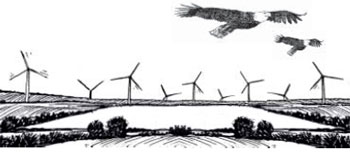
 According to a Mother Jones
article in the summer of 2002, technical
advances and economies of scale, in
addition to lucrative tax incentives, have
made wind competitive: three to six
cents per kilowatt hour, as opposed to
two to five cents for conventional fuels.
These savings are in part due to the
availability of technology capable of
ramping up turbine size to industrial
scale and taking advantage of relatively
steady wind speeds in places like
mountain ridge tops. (Offshore wind
energy, although popular in Europe,
seems stalled in this country over the
issue of offshore scenic vistas.) And
wind, placed in the right location, is far
more predictable than foreign oil, the
article argues.
According to a Mother Jones
article in the summer of 2002, technical
advances and economies of scale, in
addition to lucrative tax incentives, have
made wind competitive: three to six
cents per kilowatt hour, as opposed to
two to five cents for conventional fuels.
These savings are in part due to the
availability of technology capable of
ramping up turbine size to industrial
scale and taking advantage of relatively
steady wind speeds in places like
mountain ridge tops. (Offshore wind
energy, although popular in Europe,
seems stalled in this country over the
issue of offshore scenic vistas.) And
wind, placed in the right location, is far
more predictable than foreign oil, the
article argues.
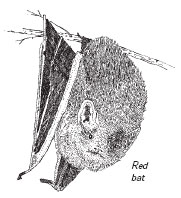
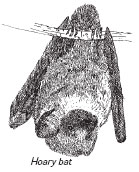 The bat mortality incident pointed
to how little is known about the ways
bats migrate and behave, particularly
around wind turbines, and a coalition of
wind energy representatives, government
agencies, and Bat Conservation
International (BCI) has hired a full-time
biologist to better understand bat interactions
before its too late to take remedial
measures. Merlin Tuttle, president of BCI,
worried in the Summer 2004 issue of Bats
magazine that bat loss may prove huge if a
buildup of wind energy were to occur. “If
the kill rates from the 44 turbines at the
Mountaineer site were scaled up to the
proposed level of 410 turbines planned for
Appalachian ridges, the turbines alone
could kill more than 30,000 bats in a single
season,” he wrote.
The bat mortality incident pointed
to how little is known about the ways
bats migrate and behave, particularly
around wind turbines, and a coalition of
wind energy representatives, government
agencies, and Bat Conservation
International (BCI) has hired a full-time
biologist to better understand bat interactions
before its too late to take remedial
measures. Merlin Tuttle, president of BCI,
worried in the Summer 2004 issue of Bats
magazine that bat loss may prove huge if a
buildup of wind energy were to occur. “If
the kill rates from the 44 turbines at the
Mountaineer site were scaled up to the
proposed level of 410 turbines planned for
Appalachian ridges, the turbines alone
could kill more than 30,000 bats in a single
season,” he wrote.
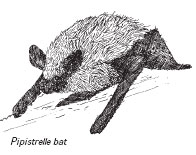 Site-specific information is crucial
to good siting decisions for
wind—although the Roth Rock
site in no way compares to the scale and
raptor concentration at Altamont, it is
still important to better understand the
key issues in siting on ridgetops and
avoid irreversible mistakes. But instead
of calling for more studies, as is suggested
in guidance documents for wind
facilities developed by the National
Wind Coordinating Committee (an
association of wind energy companies
and others), the American Bird Conservancy,
and the U.S. Fish and Wildlife
Service, Kerlinger’s assessments
presume that if you don’t see it, it isn’t
there. He writes: “few raptors collide
with turbines during day migration,”
without providing the behavioral studies
to support the statement, and that “the
morning flight of songbirds is thought
by some to be significant, but there is no
evidence to support this,” refuting the
evidence of highly respected ornithologist
Chan Robbins instead of calling for
further observation to determine if, in
fact, there might be a problem. (The
claim is that migratory songbirds
depend on ridgelines as they fly low at
dawn—within range of turbines—in
search of roosting places.)
Site-specific information is crucial
to good siting decisions for
wind—although the Roth Rock
site in no way compares to the scale and
raptor concentration at Altamont, it is
still important to better understand the
key issues in siting on ridgetops and
avoid irreversible mistakes. But instead
of calling for more studies, as is suggested
in guidance documents for wind
facilities developed by the National
Wind Coordinating Committee (an
association of wind energy companies
and others), the American Bird Conservancy,
and the U.S. Fish and Wildlife
Service, Kerlinger’s assessments
presume that if you don’t see it, it isn’t
there. He writes: “few raptors collide
with turbines during day migration,”
without providing the behavioral studies
to support the statement, and that “the
morning flight of songbirds is thought
by some to be significant, but there is no
evidence to support this,” refuting the
evidence of highly respected ornithologist
Chan Robbins instead of calling for
further observation to determine if, in
fact, there might be a problem. (The
claim is that migratory songbirds
depend on ridgelines as they fly low at
dawn—within range of turbines—in
search of roosting places.)