Revisiting Washington’s Status as the “City of Trees”
By Melanie Choukas-Bradley Download the PDF
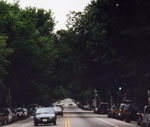
A tree-lined street in Washington, DC several decades ago. The city’s Urban Forestry Administration and Casey Trees
are working to return Washington to its former leafy status.
Photo courtesy of DC Dept. of Transportation, Urban Forestry Administration
Northeasterly breezes have broken the summer heat, and neighbors of Capitol Hill’s Lincoln Park have come out on a Saturday evening to celebrate. Children pedal tiny twowheelers around the park’s statues of Abraham Lincoln and educator Mary McLeod Bethune. The park is filled with neighborhood dogs, many of them off-leash and exuberantly chasing one another.
Jean Godwin and Craig
Steinberg, who live on opposite sides
of the park, share a bench, while their
dogs Buster and Mel chew on sticks at
their feet. “This is where the neighborhood
meets,” says Godwin. “It’s
everybody’s backyard. My kids, now
teenagers, learned to ride their bikes
here and my son learned to play ball
over there, under those trees.”
She points to a grove of willow
oaks across the park’s central square.
The trees in this park are, for the most
part, massive and healthy. Large
Japanese pagoda trees drop fragrant
yellow-green flowers on the grass and
sidewalk. Chinese chestnuts and the
acorns of saw-toothed oaks are ripening.
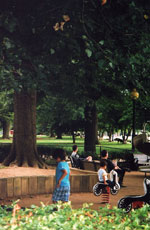
Having fun in Lincoln Park.
Photo by Melanie Choukas-Bradley
You can easily picture the park in
autumn with the foliage blazing, in
winter with a dusting of snow on the
hollies, and in early spring, when the
Asian magnolias will bloom. At this
moment in time, a late summer evening,
the scene is stunningly idyllic.
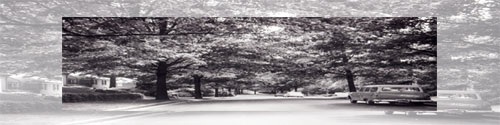
Tree-lined streets and avenues,
flanked by generous sidewalks filled
with walkers and cyclists, radiate from
every angle of Lincoln Park. The most
impressive of these is East Capitol
Street. Framed by a canopy of American
elms, the white dome of the Capitol
seems to float above it. The limbs of
the vase-shaped elms touch in the
middle of the street, forming a tunnel
like the ones so many of us remember
from childhood, before Dutch elm
disease came calling. James R. Lyons,
Undersecretary of Agriculture for
Natural Resources and Environment
during the Clinton administration,
drives through this green tunnel on his
way to his K Street office, where he
currently serves as executive director
of the Casey Trees Endowment Fund.
During his work day, Lyons holds
the verdant image of East Capitol Street
in his mind for inspiration. Because,
despite appearances in and around
Lincoln Park, all is not well in the “City
of Trees.” Satellite images reveal that
between 1973 and 1999, the District of
Columbia lost roughly half its trees,
according to Gary Moll, senior vice
president of the Urban Forest Center
at American Forests, a conservation
organization.
Based on these images and other
evidence of a declining canopy in the
District, Maryland philanthropist Betty
Brown Casey took dramatic action. By
May of 2001, the nonprofit Casey Trees
Endowment Fund was formed with a
$50 million grant from the Eugene B.
Casey Foundation. Its mission: “to
restore, enhance, and protect the tree
canopy of the District of Columbia in
cooperation with local and federal
government agencies, community
groups, and individual citizens.”
Many recent studies have
demonstrated that urban trees
contribute far more than
aesthetics. Healthy trees remove carbon
monoxide, nitrogen dioxide, sulfur
dioxide, ozone, and particulate matter
from the air. Trees combat the so-called
urban heat island effect, increase
residential and commercial property
values, and decrease the
rate of asthma
in children
(DC’s rate is
one of the
nation’s
highest). They
provide food
and shelter for
birds and
animals.
They
help to protect
our water
systems by
absorbing
stormwater
runoff, which
overwhelms
Washington’s
sewage system
during heavy
rains and has
increased dramatically due to development
and resultant tree-loss. Runoff is a
major factor contributing to the pollution
of the Anacostia and Potomac rivers and
the decline of the Chesapeake Bay.
The Casey Trees Endowment
Fund and American Forests see trees as
the answer, or partial answer, to many
ills in Washington, DC and other cities.
Barbara Deutsch, who has been with
Casey Trees almost since it opened its
doors and currently serves as senior
director for programs and research,
explains: “Our cities are in crisis and
we’re not meeting our air and water
quality standards.
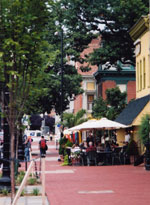
Newly-planted Princeton American elms will enhance the recently
refurbished historic business district on 8th St. SE.
Photo by Melanie Choukas-Bradley
Each municipality is
looking at millions
of dollars in improvements.
We’re
saying, ‘Hey, wait a
minute, there are
other solutions.’ If
we look at the city
holistically, our
‘green infrastructure’
can work with
the existing gray
infrastructure to
help solve our city
air and water
quality problems.”
American
Forests has taken
this one step further.
“Since 1996, when
we put our first
software together
[to map and evaluate urban trees], our
focus has been to try to put a dollar
value on trees for air and water and
energy,” says Moll. “Trees have a
tremendous value. If a city manager is
balancing a budget, you’ll find that you
ought to have a substantial tree canopy.”
Trees have always been central to
the quality of life in Washington,
but the city’s trees have had
something of a boom or bust history.
George Washington, founder of the
nation’s capital, would probably be
called a tree-hugger today, as would
Thomas Jefferson and several other past
American presidents. When Washington
hired Major Pierre Charles L’Enfant to
design the federal city, the two made
sure that it would be a verdant capital,
blessed with green space and bountiful
groves of trees. But their vision floundered
badly in the 19th century.
Thomas Jefferson, who personally
designed the city’s first street-tree
planting, was forced to witness the
widespread felling of trees for fuel and
profit during his administration in the
early 1800s. He even expressed a fleeting
wish for despotic powers to “save the
noble, the beautiful trees that are daily
falling sacrifices to the cupidity of their
owners or the necessity of the poor,” and
he remarked: “The unnecessary felling of
a tree seems to me a crime little short of
murder; it pains me to an unspeakable
degree.”
By the mid-1800s, the haphazard
cutting of trees—combined with a
casual attitude toward sewage disposal—
had rendered summer in Washington
a life-threatening proposition.
Presidents were forced to leave the
White House for fear they would fall
habit of the beloved American elm. In
riparian environments along the
Anacostia, the city and Casey Trees
have joined forces with Americorps*
NCCC, the Chesapeake Bay
Foundation, and the National Park
Service to plant native trees suited to
riverbanks—sycamore, green ash,
swamp white oak, and sweetgum, for
example.
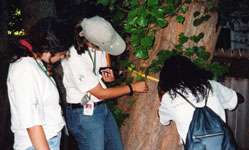
Olivia Watts (center) helps Sujey Chopin (left) and Alicia
Thomas (right) determine the DBH (diameter at breast
height) of a black locust tree during UFORE survey
Photo by Melanie Choukas-Bradley
Casey Trees sees educating and
enlisting DC’s youngest citizens in the
regreening of the city as another central
aspect of its mission. Lyons says: “We
have had high school kids from every
ward of the city involved this summer.”
These paid interns alternated between
participating in maintenance and taking
a tree inventory for the Urban Forest Effects
Survey (UFORE), designed to evaluate the city’s tree
canopy for its contributions to a healthy environment.
On a recent summer morning I
joined one of the UFORE teams in the
field. Olivia Watts, a 20-year-old forestry
major at Virginia Tech, was one of three
college interns Casey had hired to head
up UFORE teams during the summer.
The UFORE survey involved two
hundred 37½-foot-radius plots throughout
the city, including both public and
private land of every sort of land use.
Each plot was visited by a UFORE team
that studied the overall health of the
and measured each tree so it could be
documented for its contribution to air
quality and cooling. The data collected
goes into a USDA Forest Service
computer model so that researchers can
measure and evaluate DC’s urban forest
for temperature reduction, removal of air
pollutants, energy effects, and
stormwater runoff.
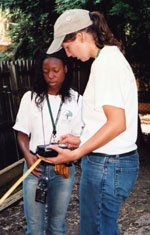
Olivia Watts helps Alicia Thomas measure the
crown width of a black locust tree (UFORE Survey)
Photo by Melanie Choukas-Bradley
On this particular day, Watts was
working with 16-year-old Alicia Thomas,
a rising sophomore at Eastern
Senior High School in northeast DC, and
18-year- old Sujey Chopin, who was born
in El Salvador and will be a senior at
Roosevelt Senior High in northwest DC
The internship was the first real job for
both high school girls and they said it
was hard work, particularly
on the non-UFORE
days when they would go
out with the maintenance
crews to water, stake and
mulch Casey’s young
trees.
We rode a Metro
train and bus to northwest
DC and then walked
to Jenifer Street, where
the trio would survey the
first plot of the day. A
German shepherd barked
when Watts knocked on a
townhouse door, but prior
written permission from
the property owners had
already been obtained,
and the team was soon
through the wooden gates
and into the two backyards
and alleyway that
made up the survey plot.
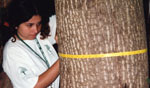
Sujey Chopin measures the DBH of a tulip tree
on Jenifer St., NW
Photo by Melanie Choukas-Bradley
After putting a
central yellow stake in the
ground, Watts and the
girls began determining
the radius and circumference of the plot.
They then estimated areas of shrub
cover, impervious surface, herbaceous
plant and woody vine cover, and duff/
mulch. “Remember that one percent of
the plot is about the size of a queen size
mattress,” prompted Watts.
The lion’s share of the work
involved measuring each tree in the
townhouse backyards and along the
alley. Watts easily identified the species,
which included a tulip tree and a black
locust. She then helped the girls use the
tools of the trade: a large tape measure
to determine DBH (diameter at breast
height), crown width, and distance of
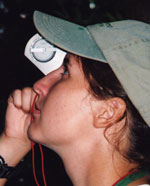
each tree from residences; a hand-held
range finder; and a clinometer for
determining the trees’ bole height (height
of the trunk) and total height. When the
electronic range finder failed, as it often
did, the team relied on the old-fashioned
clinometer. Watts entered all the information
into her hand-held computer.
Olivia Watts uses a clinometer to determine a tree’s height
Photo by Melanie Choukas-Bradley
Many tree plantings in the city are
accomplished with the help of a Citizen
Forester program, initiated by Casey
Trees and supported by Mayor Williams
and the Urban Forestry Administration,
the National Park Service,
University of the District of Columbia,
the USDA Forest Service, and the
National Arboretum. Citizen foresters
participate in three training modules and
put in a specified number of volunteer
hours. During the first module they learn
about tree identification and biology,
and how to measure trees and
evaluate their health. The second
module teaches citizen foresters how
to plant and care for trees. Casey Trees has
begun planting trees in earnest, and
during spring and fall tree-planting
sessions the foresters work with
other local volunteers who come out
on tree planting days to help plant
and learn about tree care in their
communities.
The third module teaches urban
ecology, environmental stewardship,
and community outreach.
Citizen foresters have helped
plant more than 1,000 trees, and they
have been vital contributors to three
major tree inventories: the 2002
summer street tree inventory; a 2003-
2004 survey of National Park lands
around the Mall and some city
parks—a Casey Trees collaboration
with the National Park Service; and
this past summer’s “Urban Forest
Effects” (UFORE) survey—a joint
project with Casey Trees, the
National Park Service and the USDA
Forest Service.
Will East Capitol Street’s “tunnel of trees”
be the wave of the future?
We hope so!
Photo by Melanie Choukas-Bradley
Claudine Lebeau is a citizen
forester, one of 45 who have been
trained in all three modules (in effect,
Casey Trees’ first graduating class).
Born and raised in France, a mother
7 of two who is employed by GEICO, Lebeau volunteers for Casey Trees
whenever she can. Her favorite aspect of volunteering involves the
inventories. “I joined to understand trees and to be closer to trees,”
she says. “When you spend 15-20 minutes
with each tree, you feel like you are
discovering nature.” She also says, “I am
impressed with the technology [for
measuring trees and recording data].
Using it properly takes a lot of experience.”
Lebeau participates in planting
sessions two Saturdays a month during
spring and fall. “Planting is a festive
event,” she says. “Volunteers come
from all over the city and we have
coffee and bagels. It’s great for people
in the neighborhoods who are gregarious.
They are paired with experienced
planters.” She also describes it as hard
work, “especially when digging in
compacted soil,” a job young
Americorps volunteers often assist
with. Newly planted trees are mulched and watered.
“Getting water can be quite a challenge,”
she says. It is often hauled in buckets from residential faucets
by the citizen foresters and other volunteers.
As I explore the streets and parks of Washington
myself, preparing to write a new edition
of City of Trees, I see many streets
with dead and dying trees, and I know
that the capital is not as green as it
was just 27 years ago when I first
moved to the city.
But my heart is
lightened by the high-tech career and
volunteer arborists of the 21st century,
and their passion to restore the urban
canopy. Not far from the leafy elm
tunnel of East Capitol Street lies 8th
Street, SE or “Barracks Row,” a newly
refurbished historic business district
near Eastern Market with wide brick
sidewalks and young Princeton
American elms planted by Mayor
Williams, District business and
community leaders, Casey Trees and
its volunteers, during a snowfall last
December. I look into the future and
imagine the vase-shaped branches of
these disease-resistant American elms
touching in the middle of the street,
forming a green tunnel that will cool a
hot summer day.
As the Casey Trees Endowment
Fund opined in a recent report titled The
State of Our Trees: The Status and Health
of the Street Trees of Washington DC:
“Trees…reduce stress, add character and
peace to neighborhoods…They are the
front-line buffer between the harsh, hot
pavement of city streets and the spaces
where we walk, play, live and work.”
As long as current trends continue,
and the trees of Washington have the
ongoing support of the District and
federal governments, organizations such
as Casey Trees and American Forests,
and the committed green thumbs of its
citizens, the forecast looks promising.
Free–lance writer Melanie
Choukas-Bradley is at work on a revision
of City of Trees: The Complete Field
Guide to the Trees of Washington, DC,
illustrated by Polly Alexander. She is also
the author of two books about Sugarloaf
Mountain, illustrated by Tina Thième
Brown and published by the University of
Virginia Press, as well as a number of
articles published in The Washington Post.
Melanie and Tina will lead an ANS field
trip to Sugarloaf on November 13th .





 The trees in this park are, for the most
part, massive and healthy. Large
Japanese pagoda trees drop fragrant
yellow-green flowers on the grass and
sidewalk. Chinese chestnuts and the
acorns of saw-toothed oaks are ripening.
The trees in this park are, for the most
part, massive and healthy. Large
Japanese pagoda trees drop fragrant
yellow-green flowers on the grass and
sidewalk. Chinese chestnuts and the
acorns of saw-toothed oaks are ripening.
 The Casey Trees Endowment
Fund and American Forests see trees as
the answer, or partial answer, to many
ills in Washington, DC and other cities.
Barbara Deutsch, who has been with
Casey Trees almost since it opened its
doors and currently serves as senior
director for programs and research,
explains: “Our cities are in crisis and
we’re not meeting our air and water
quality standards.
The Casey Trees Endowment
Fund and American Forests see trees as
the answer, or partial answer, to many
ills in Washington, DC and other cities.
Barbara Deutsch, who has been with
Casey Trees almost since it opened its
doors and currently serves as senior
director for programs and research,
explains: “Our cities are in crisis and
we’re not meeting our air and water
quality standards.